Schuler, Benedikt Alexander; Murmann, Johann Peter; Beisemann, Marie; Satopää, Ville Individual foresight: Concept, operationalization, and correlates Journal Article In: International Journal of Forecasting, vol. 41, no. 4, pp. 1521–1538, 2025, ISSN: 0169-2070. Murmann, Johann Peter In: Manag. Organ. Rev., vol. 20, no. 4, pp. 695–696, 2024, ISSN: 1740-8784. Abstract | Links | BibTeX | Tags: Kapoor, Rahul; Murmann, Johann Peter The organizational and technological origins of the U.S. shale gas revolution, 1947 to 2012 Journal Article In: vol. 33, no. 1, pp. 106–125, 2024, ISSN: 1464-3650. Abstract | Links | BibTeX | Tags: Murmann, Johann Peter The Rise of China and the Specter of a Superpower War: Avoiding the Curse of History at the Grassroots Journal Article In: Management and Organization Review, vol. 20, no. 6, pp. 946–957, 2024. Abstract | Links | BibTeX | Tags: China, Innovation, Superpower Conflict Murmann, Johann Peter Debate on Informal Interpersonal Networks: Guanxi vs. Wasta Journal Article In: Manag. Organ. Rev., vol. 19, no. 5, pp. 1039–1039, 2023, ISSN: 1740-8784. Abstract | Links | BibTeX | Tags: Jiang, Hong; Murmann, Johann Peter Functional Knowledge versus Strategic Knowledge: What Type of Knowledge Matters Most for the Long-Term Performance of Startups Journal Article In: Management and Organization Review, vol. 19, no. 3, pp. 417-461, 2023. Abstract | Links | BibTeX | Tags: China, Dye Industry, Innovation Jiang, Hong; Murmann, Johann Peter The Rise of China's Digital Economy: An Overview Journal Article In: Management and Organization Review, vol. 18, no. 4, pp. 790–802, 2022. Abstract | Links | BibTeX | Tags: China, Innovation Hochstrasser, Annika; Murmann, Johann Peter China Innovation Capacity Growth Index 2015 and 2020 Journal Article In: Management and Organization Review, vol. 17, no. 4, pp. 861-867, 2021. Abstract | Links | BibTeX | Tags: Innovation, Innovation Index Murmann, Johann Peter; Guo, Bin; Huang, Can A Dynamic Perspective on Huawei Journal Article In: Management and Organization Review, vol. 17, no. 5, pp. 1087-1100, 2021. Abstract | Links | BibTeX | Tags: Change, Dynamic Capabilities, Huawei, Routines Murmann, Johann Peter; Zhu, Zhijing In: Strategy Science, vol. 6, no. 4, pp. 265-445, 2021. Abstract | Links | BibTeX | Tags: Coopetition, Evolutionary Theory, Tencent, WeChat Murmann, Johann Peter Historical methods in the social sciences: Commentary on Schoemaker 2020 Journal Article In: Futures & Foresight Science, vol. 2, no. 3-4, 2020, ISSN: 2573-5152. Murmann, Johann Peter; Huang, Can; Zhang, Haoyu Huawei’s Intellectual Property Management Transformation Book Chapter In: Wu, Xiaobo; Murmann, Johann Peter; Huang, Can; Guo, Bin (Ed.): The Management Transformation of Huawei: From Humble Beginnings to Global Leadership, Chapter 9, pp. 347–380, Cambridge University Press, 2020. Abstract | Links | BibTeX | Tags: Change, Huawei, Innovation, IP, Patents Wu, Xiaobo; Murmann, Johann Peter; Huang, Can; Guo, Bin The Management Transformation of Huawei: From Humble Beginnings to Global Leadership Book Cambridge University Press, 2020. Abstract | Links | BibTeX | Tags: Change, Dynamic Capabilities, Evolutionary Theory, Huawei, Routines Murmann, Johann Peter The Management Transformation of Huawei: An Overview Book Chapter In: Wu, Xiaobo; Murmann, Johann Peter; Huang, Can; Guo, Bin (Ed.): The Management Transformation of Huawei: From Humble Beginnings to Global Leadership, pp. 1–70, Cambridge University Press, 2020. Abstract | Links | BibTeX | Tags: Change, Dynamic Capabilities, Evolutionary Theory, Huawei, Routines Zhang, Zihan; Murmann, Johann Peter Transforming Product Development at Huawei: The IPD Initiative Book Chapter In: Wu, Xiaobo; Murmann, Johann Peter; Huang, Can; Guo, Bin (Ed.): The Management Transformation of Huawei: From Humble Beginnings to Global Leadership, Chapter 3, pp. 110–135, Cambridge University Press, 2020. Abstract | Links | BibTeX | Tags: Change, New Products, Routines Xu, Hongqi; Murmann, Johann Peter The Transformation of Huawei’s HR System Book Chapter In: Wu, Xiaobo; Murmann, Johann Peter; Huang, Can; Guo, Bin (Ed.): The Management Transformation of Huawei: From Humble Beginnings to Global Leadership, Chapter 6, pp. 209–243, Cambridge University Press, 2020. Abstract | Links | BibTeX | Tags: Change, HR Systems, Huawei, Routines Murmann, Johann Peter The Management Transformation of Huawei: Concluding Thoughts from a Comparative Perspective Book Chapter In: Wu, Xiaobo; Murmann, Johann Peter; Huang, Can; Guo, Bin (Ed.): The Management Transformation of Huawei: From Humble Beginnings to Global Leadership, Chapter 10, pp. 381–410, Cambridge University Press, 2020. Abstract | Links | BibTeX | Tags: Dynamic Capabilities, Evolutionary Theory, Huawei, Private Enterprise, SOEs Li, Lanhua; Guo, Bin; Murmann, Johann Peter; Wu, Dong Huawei’s R&D Management Transformation Book Chapter In: Wu, Xiaobo; Murmann, Johann Peter; Huang, Can; Guo, Bin (Ed.): The Management Transformation of Huawei: From Humble Beginnings to Global Leadership, Chapter 8, pp. 292–346, Cambridge University Press, 2020. Abstract | Links | BibTeX | Tags: Change, Dynamic Capabilities, Huawei, Innovation, R&D, Routines Bhagavatula, Suresh; Mudambi, Ram; Murmann, Johann Peter Innovation and Entrepreneurship in India: An Overview Journal Article In: Manag. Organ. Rev., vol. 15, no. 03, pp. 467–493, 2019, ISSN: 1740-8784. Abstract | Links | BibTeX | Tags: Perkins, Greg; Murmann, Johann Peter What Does the Success of Tesla Mean for the Future Dynamics in the Global Automobile Sector? Journal Article In: Management and Organization Review, vol. 14, no. 3, pp. 471–480, 2018. Abstract | Links | BibTeX | Tags: autos, Innovation, Tesla Lewin, Arie Y.; Chiu, Chi-Yue; Fey, Carl F.; Levine, Sheen S.; McDermott, Gerald; Murmann, Johan Peter; Tsang, Eric The Critique of Empirical Social Science: New Policies atManagement and Organization Review Journal Article In: Manag. Organ. Rev., vol. 12, no. 4, pp. 649–658, 2016, ISSN: 1740-8784. Abstract | Links | BibTeX | Tags: Brenner, Thomas; Murmann, Johann Peter Using simulation experiments to test historical explanations: the development of the German dye industry 1857-1913 Journal Article In: J Evol Econ, vol. 26, no. 4, pp. 907–932, 2016, ISSN: 1432-1386. Lewin, Arie Y.; Kenney, Martin; Murmann, Johann Peter China’s innovation challenge: Concluding reflections Book Chapter In: Lewin, Arie Y.; Kenney, Martin; Murmann, Johann PeterEditors (Ed.): China's Innovation Challenge: Overcoming the Middle-Income Trap, Chapter 16, pp. 418–425, Cambridge University Press, 2016. Abstract | Links | BibTeX | Tags: Innovation, Innovation Index Lewin, Arie Y.; Kenney, Martin; Murmann, Johann Peter China’s innovation challenge: An introduction Book Chapter In: Lewin, Arie Y.; Kenney, Martin; Murmann, Johann Peter (Ed.): China's Innovation Challenge: Overcoming the Middle-Income Trap, Chapter 10, pp. 1–31, Cambridge University Press, 2016. Abstract | Links | BibTeX | Tags: Innovation Lewin, Arie Y.; Kenney, Martin; Murmann, Johann Peter (Ed.) China's Innovation Challenge: Overcoming the Middle-Income Trap Book Cambridge University Press, 2016. Abstract | Links | BibTeX | Tags: Innovation Murmann, Johann Peter Nelson, Richard R. (Born 1930) Book Chapter In: The Palgrave Encyclopedia of Strategic Management, pp. 1–4, Palgrave Macmillan UK, 2016, ISBN: 9781349948482. Bermiss, Y. Sekou; Murmann, Johann P. Who matters more? The impact of functional background and top executive mobility on firm survival Journal Article In: Strategic Management Journal, vol. 36, no. 11, pp. 1697–1716, 2015, ISSN: 1097-0266. Abstract | Links | BibTeX | Tags: Murmann, Johann Peter China’s Path to Innovation by Xiaolan Fu Online 2015, visited: 28.07.2015. Abstract | Links | BibTeX | Tags: Innovation Murmann, Johann Peter Deepening the conversation between business history and evolutionary economics Journal Article In: Business History, vol. 57, no. 5, pp. 705–715, 2015, ISSN: 1743-7938. Murmann, Johann Peter; Ozdemir, Salih Zeki; Sardana, Deepak The role of home country demand in the internationalization of new ventures Journal Article In: Research Policy, vol. 44, no. 6, pp. 1207–1225, 2015, ISSN: 0048-7333. Murmann, Johann Peter Evolutionary Perspectives Book Chapter In: vol. 11, pp. 1–1, Wiley, 2015. Abstract | Links | BibTeX | Tags: Murmann, Johann Peter; Korn, Jenny; Worch, Hagen How Fast Can Firms Grow? Journal Article In: vol. 234, no. 2-3, pp. 210–233, 2014, ISSN: 2366-049X. Abstract | Links | BibTeX | Tags: Murmann, Johann Peter Reflections on Choosing the Appropriate Level of Abstraction in Social Science Research Journal Article In: Management and Organization Review, vol. 10, no. 3, pp. 381–389, 2014. Abstract | Links | BibTeX | Tags: Private Enterprise, SOEs, Unit of Analysis Murmann, Johann Peter Scaffolding in Economics, Management, and the Design of Technologies Book Chapter In: Developing Scaffolds in Evolution, Culture, and Cognition, pp. 287–306, The MIT Press, 2013, ISBN: 9780262314787. Murmann, J. P. The co-development of industrial sectors and academic disciplines Journal Article In: Science and Public Policy, vol. 40, no. 2, pp. 229–246, 2013, ISSN: 1471-5430. Murmann, Johann Peter; Sardana, Deepak Successful entrepreneurs minimize risk Journal Article In: Australian Journal of Management, vol. 38, no. 1, pp. 191–215, 2013, ISSN: 1327-2020. Abstract | Links | BibTeX | Tags: Murmann, Johann Peter The Coevolution of Industries and Important Features of Their Environments Journal Article In: Organization Science, vol. 24, no. 1, pp. 58–78, 2013, ISSN: 1526-5455. Abstract | Links | BibTeX | Tags: Murmann, Johann Peter Marrying History and Social Science in Strategy Research Book Chapter In: Advances in Strategic Management, pp. 89–115, Emerald Group Publishing Limited, 2012, ISBN: 9781781900253. Jiang, Hong; Murmann, Johann Peter In: Industrial and Corporate Change, vol. 21, no. 4, pp. 933-970, 2011, ISSN: 0960-6491. Abstract | Links | BibTeX | Tags: COEs, Corporate Forms, Dye Industry, Evolutionary Theory, Private Enterprise, Regional Advantage, SOEs Murmann, Johann Peter Constructing Relational Databases to Study Life Histories on Your PC or Mac Journal Article In: Historical Methods: A Journal of Quantitative and Interdisciplinary History, vol. 43, no. 3, pp. 109–123, 2010, ISSN: 1940-1906. Järvinen, Joonas; Lamberg, Juha-Antti; Murmann, Johan-Peter; Ojala, Jari Alternative Paths to Competitive Advantage: A Fuzzy-Set Analysis of the Origins of Large Firms Journal Article In: Industry and Innovation, vol. 16, no. 6, pp. 545–574, 2009, ISSN: 1469-8390. MURMANN, JOHANN PETER; HOMBURG, ERNST; GEVEN, RUUD; BERMISS, Y. SEKOU; FORGIONE, ALFONZO Automatic Coding of Printed Materials Journal Article In: IJHAC, vol. 1, no. 2, pp. 151–185, 2007, ISSN: 1755-1706. Murmann, Johann Peter; Frenken, Koen Toward a systematic framework for research on dominant designs, technological innovations, and industrial change Journal Article In: Research Policy, vol. 35, no. 7, pp. 925–952, 2006, ISSN: 0048-7333. Buenstorf, Guido; Murmann, Johann Peter Ernst Abbe’s scientific management: theoretical insights from a nineteenth-century dynamic capabilities approach Journal Article In: vol. 14, no. 4, pp. 543–578, 2005, ISSN: 1464-3650. Murmann, Johann Peter; Frenken, Koen Toward a Systematic Framework for Research on Dominant Designs, Technological Innovations, and Industrial Change Book Chapter In: Potts, Jason; Dopfer, Kurt (Ed.): Elsevier BV, 2005, ISSN: 1556-5068. Murmann, Johann Peter Knowledge and Competitive Advantage Book Cambridge University Press, 2003. Abstract | Links | BibTeX | Tags: Stephan, John; Murmann, Johann Peter; Boeker, Warren; Goodstein, Jerry Bringing Managers into Theories of Multimarket Competition: CEOs and the Determinants of Market Entry Journal Article In: Organization Science, vol. 14, no. 4, pp. 403–421, 2003, ISSN: 1526-5455. Abstract | Links | BibTeX | Tags: Murmann, Johann Peter; Tushman, Michael From the Technology Cycle to the Entrepreneurship Dynamic: The Social Context of Entrepreneurial Innovation Book Chapter In: Schoonhoven, Claudia Bird; Romanelli, Elaine (Ed.): vol. 1, pp. 178-206, Emerald, 2003, ISSN: 1462-6004. Murmann, Johann Peter; Aldrich, Howard E.; Levinthal, Daniel; Winter, Sidney G. Evolutionary Thought in Management and Organization Theory at the Beginning of the New Millennium Journal Article In: Journal of Management Inquiry, vol. 12, no. 1, pp. 22–40, 2003, ISSN: 1552-6542. Abstract | Links | BibTeX | Tags: Murmann, Johann Peter; Aldrich, Howard E.; Levinthal, Daniel; Winter, Sidney G. Evolutionary Thought in Management and Organization Theory at the Beginning of the New Millennium Book Chapter In: Child, John (Ed.): vol. 12, no. 1, pp. 22–40, SAGE Publications, 2003, ISSN: 1552-6542. Abstract | Links | BibTeX | Tags: 2025

@article{Schuler2025,
title = {Individual foresight: Concept, operationalization, and correlates},
author = {Benedikt Alexander Schuler and Johann Peter Murmann and Marie Beisemann and Ville Satopää},
doi = {10.1016/j.ijforecast.2025.01.003},
issn = {0169-2070},
year = {2025},
date = {2025-10-00},
urldate = {2025-10-00},
journal = {International Journal of Forecasting},
volume = {41},
number = {4},
pages = {1521--1538},
publisher = {Elsevier BV},
keywords = {},
pubstate = {published},
tppubtype = {article}
}
2024
@article{Murmann2024b,
title = {Editor's Introduction to a Discussion, Debate, and Dialogue (D3) Forum on the Similarities and Differences between Medical and Management Research},
author = {Johann Peter Murmann},
doi = {10.1017/mor.2024.25},
issn = {1740-8784},
year = {2024},
date = {2024-08-00},
urldate = {2024-08-00},
journal = {Manag. Organ. Rev.},
volume = {20},
number = {4},
pages = {695--696},
publisher = {Cambridge University Press (CUP)},
abstract = {<jats:p>In the previous issue (Vol. 20, Issue 3), we published a perspective article entitled ‘Responsible Research: Reflections of Two Business Scholars Doing Mental Health Research during COVID-19’, by Zhang and Chen. The pair represents two management scholars who ventured into medical research during the COVID pandemic. Zhang and Chen shared their insights from this exploration with the broader community of management scholars, highlighting key differences in how the field of medicine balances the goals of rigor and relevance and judges what research deserves to be published.</jats:p>},
keywords = {},
pubstate = {published},
tppubtype = {article}
}

@article{Kapoor2023,
title = {The organizational and technological origins of the U.S. shale gas revolution, 1947 to 2012},
author = {Rahul Kapoor and Johann Peter Murmann},
doi = {10.1093/icc/dtad021},
issn = {1464-3650},
year = {2024},
date = {2024-01-30},
urldate = {2024-01-30},
volume = {33},
number = {1},
pages = {106--125},
publisher = {Oxford University Press (OUP)},
abstract = {<jats:title>Abstract</jats:title>
<jats:p>We explore the origins and the development of hydraulic fracking technology that made possible United States’ unexpected rise as a top producer of oil and gas. As hydraulic fracking was first used extensively to produce shale gas and only later to produce shale oil, we focus on analyzing what is often referred to as the “shale gas revolution.” We trace how the shale gas ecosystem evolved, what role different actors played in the unexpected shale gas revolution, and how the strategies and knowledge bases of the different actors differed and evolved over time.</jats:p>},
keywords = {},
pubstate = {published},
tppubtype = {article}
}
<jats:p>We explore the origins and the development of hydraulic fracking technology that made possible United States’ unexpected rise as a top producer of oil and gas. As hydraulic fracking was first used extensively to produce shale gas and only later to produce shale oil, we focus on analyzing what is often referred to as the “shale gas revolution.” We trace how the shale gas ecosystem evolved, what role different actors played in the unexpected shale gas revolution, and how the strategies and knowledge bases of the different actors differed and evolved over time.</jats:p>@article{Murmann_2024,
title = {The Rise of China and the Specter of a Superpower War: Avoiding the Curse of History at the Grassroots},
author = {Johann Peter Murmann},
doi = {10.1017/mor.2024.51},
year = {2024},
date = {2024-01-01},
urldate = {2024-01-01},
journal = {Management and Organization Review},
volume = {20},
number = {6},
pages = {946–957},
abstract = {Johann Peter Murmann’s “The Rise of China and the Specter of a Superpower War: Avoiding the Curse of History at the Grassroots” (2024) is both a scholarly reflection on China’s extraordinary economic ascent and a call for academic and civic engagement to prevent a new superpower conflict.
Murmann begins by tracing his decades-long research into innovation and industrial evolution, starting from the 19th-century synthetic dye industry. His early work on Germany’s leadership in dyes evolved into studying China’s dominance in that field after 1995. He attributes China’s success to regional policy variations, entrepreneurial dynamism, and local institutional flexibility—factors often underestimated in Western analyses.
As deputy editor of Management and Organization Review (MOR), Murmann focused on China’s transition from imitation to innovation. He co-edited China’s Innovation Challenge (2016), which debated whether China could avoid the “middle-income trap.” While Justin Lin predicted continued growth without systemic reform, Gordon Redding argued that reaching U.S. income levels required decentralization. Murmann’s empirical studies later confirmed China’s increasing innovation capacity between 2015–2020, though challenges remain in private-sector autonomy and academic freedom.
Examining sectors like digital technology, electric vehicles, and telecommunications, Murmann highlights how Chinese firms such as Huawei, Tencent, BYD, and NIO leveraged intense domestic competition, government support, and large-scale market experimentation to innovate globally. Yet this industrial rise parallels growing geopolitical tension with the United States. Drawing historical analogies to pre–World War I Germany and Britain, Murmann warns that structural rivalry could lead to catastrophic conflict—what Graham Allison terms “Thucydides’s Trap.”
Murmann concludes by urging educators, especially management scholars, to foster grassroots understanding between China and the West. Echoing Immanuel Kant and Chinese philosopher Kang Youwei, he envisions a “great community” of peaceful coexistence. He calls for intellectual exchange, humility, and dialogue to “bend the arc of history” away from war and toward mutual prosperity and perpetual peace.},
keywords = {China, Innovation, Superpower Conflict},
pubstate = {published},
tppubtype = {article}
}
Murmann begins by tracing his decades-long research into innovation and industrial evolution, starting from the 19th-century synthetic dye industry. His early work on Germany’s leadership in dyes evolved into studying China’s dominance in that field after 1995. He attributes China’s success to regional policy variations, entrepreneurial dynamism, and local institutional flexibility—factors often underestimated in Western analyses.
As deputy editor of Management and Organization Review (MOR), Murmann focused on China’s transition from imitation to innovation. He co-edited China’s Innovation Challenge (2016), which debated whether China could avoid the “middle-income trap.” While Justin Lin predicted continued growth without systemic reform, Gordon Redding argued that reaching U.S. income levels required decentralization. Murmann’s empirical studies later confirmed China’s increasing innovation capacity between 2015–2020, though challenges remain in private-sector autonomy and academic freedom.
Examining sectors like digital technology, electric vehicles, and telecommunications, Murmann highlights how Chinese firms such as Huawei, Tencent, BYD, and NIO leveraged intense domestic competition, government support, and large-scale market experimentation to innovate globally. Yet this industrial rise parallels growing geopolitical tension with the United States. Drawing historical analogies to pre–World War I Germany and Britain, Murmann warns that structural rivalry could lead to catastrophic conflict—what Graham Allison terms “Thucydides’s Trap.”
Murmann concludes by urging educators, especially management scholars, to foster grassroots understanding between China and the West. Echoing Immanuel Kant and Chinese philosopher Kang Youwei, he envisions a “great community” of peaceful coexistence. He calls for intellectual exchange, humility, and dialogue to “bend the arc of history” away from war and toward mutual prosperity and perpetual peace.2023
@article{Murmann2023,
title = {Debate on Informal Interpersonal Networks: \textit{Guanxi} vs. \textit{Wasta}},
author = {Johann Peter Murmann},
doi = {10.1017/mor.2023.35},
issn = {1740-8784},
year = {2023},
date = {2023-10-00},
urldate = {2023-10-00},
journal = {Manag. Organ. Rev.},
volume = {19},
number = {5},
pages = {1039--1039},
publisher = {Cambridge University Press (CUP)},
abstract = {<jats:p>MOR's D3 section seeks to stimulate dialogue, debate, and discussion among scholars. When I took over as editor of D3, MOR's editorial team brainstormed how to further develop the D3 feature. We agreed that in addition to seeking original articles, we also wanted to encourage debate on articles that have already appeared in MOR. In this issue, we publish a commentary on Shaalan, Eid, and Tourky's (2022) article ‘De-Linking from Western Epistemologies: Using <jats:italic>Guanxi</jats:italic>-Type Relationships to Attract and Retain Hotel Guests in the Middle East’. The commentary, entitled ‘Questioning the Appropriateness of Examining <jats:italic>Guanxi</jats:italic> in a <jats:italic>Wasta</jats:italic> Environment: Why Context Should Be Front and Center in Informal Network Research’, has been written by Horak, Abosag, Hutchings, Alsarhan, Ali, Al-Twal, Weir, ALHussan, and AL-Husan (2023). As their title suggests, the commentators take issue with transferring the concept of <jats:italic>guanxi</jats:italic> into an environment in which another idea about informal interpersonal networks, <jats:italic>wasta</jats:italic>, already exists. I sense that the desire to write a critical comment was fueled by the fact that Shaalan et al. (2022) never referred to the concept of ‘<jats:italic>wasta</jats:italic>’ in their original article. We invited the authors of the original article to write a rejoinder (Shaalan, Eid, & Tourky, 2023) in which they emphasize even further that they only argue that <jats:italic>guanxi</jats:italic>-type relationships exist in the Middle East and not that <jats:italic>guanxi</jats:italic> itself exists.</jats:p>},
keywords = {},
pubstate = {published},
tppubtype = {article}
}

@article{jiang_murmann_2022,
title = {Functional Knowledge versus Strategic Knowledge: What Type of Knowledge Matters Most for the Long-Term Performance of Startups},
author = {Hong Jiang and Johann Peter Murmann},
doi = {10.1017/mor.2021.77},
year = {2023},
date = {2023-03-01},
urldate = {2023-03-01},
journal = {Management and Organization Review},
volume = {19},
number = {3},
pages = {417-461},
publisher = {Cambridge University Press},
abstract = {Past studies have shown that the flow of knowledge from incumbent firms is associated with the creation of startups and their subsequent performance. While much research has focused on the mechanisms of how incumbent-to-startup knowledge transfer takes place, such as entrepreneurs pursuing opportunities that their previous employers do not want to pursue, we explore with detailed qualitative analysis of six private startups in the Chinese synthetic-dye industry what type of knowledge actually flows and what type is more important for the long-term success of startups. We discover eight types of knowledge that flow from incumbents to new firms during the foundation of startups. Abstracting these eight types of knowledge into two general categories of functional knowledge and strategic knowledge, we find the reception of strategic (not functional) knowledge shapes the long-term competitiveness of surviving startups. Receiving technical knowledge – one type of functional knowledge – during the founding period is necessary for startups’ short-term survival but insufficient for long-term success. Our findings show that the performance implications of initial knowledge flows from incumbents hinge on the type of knowledge, contributing to a more explicit explanation of how incumbent-to-startup knowledge flows affect entrepreneurial performance.},
keywords = {China, Dye Industry, Innovation},
pubstate = {published},
tppubtype = {article}
}
2022

@article{jiang_murmann_2022b,
title = {The Rise of China's Digital Economy: An Overview},
author = {Hong Jiang and Johann Peter Murmann},
url = {https://u.pcloud.link/publink/show?code=XZdrWSVZ00bHtvQxTW7YQQalH06dKJXL3Loy},
doi = {10.1017/mor.2022.32},
year = {2022},
date = {2022-01-01},
urldate = {2022-01-01},
journal = {Management and Organization Review},
volume = {18},
number = {4},
pages = {790–802},
publisher = {Cambridge University Press},
abstract = {To stimulate a debate about the rise of China's digital economy, this essay compares China and the US in one key area of the digital economy – e-commerce and internet-based services. China still lags behind the US in internet penetration, but it distinguishes itself by building a mobile-first, fiber-intensive, and inclusive digital infrastructure. A favorable infrastructure, innovations tailored to the large Chinese market, and local firms’ rapid commercialization of products and services turned the world's largest domestic population into active online consumers, helping China overtake the US by a large margin in retail e-commerce and digital payment. While China translated digital technologies into leading business-to-customer and customer-to-customer businesses, it has not been so successful in business-to-business services. The US is still ahead in the general-purpose technologies underlying the digital economy.},
keywords = {China, Innovation},
pubstate = {published},
tppubtype = {article}
}
2021
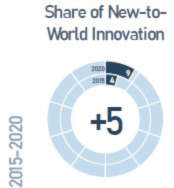
@article{hochstrasser_murmann_2021,
title = {China Innovation Capacity Growth Index 2015 and 2020},
author = {Annika Hochstrasser and Johann Peter Murmann},
doi = {10.1017/mor.2021.59},
year = {2021},
date = {2021-01-01},
urldate = {2021-01-01},
journal = {Management and Organization Review},
volume = {17},
number = {4},
pages = {861-867},
publisher = {Cambridge University Press},
abstract = {It is of interest in China and across the world to predict whether China will catch up with the most economically advanced nations in innovation capacity. To facilitate an ongoing assessment of China's innovation capacity, the article develops a China Innovation Capacity Growth Index composed of eight separate measures. China's performance in 2020 is compared to the baseline from 2015, showing that China has progressed in six of the eight measures. This article and the accompanying Technical Appendix explain each of the measures, including the sources for the data, and report the changes in performance over time.},
keywords = {Innovation, Innovation Index},
pubstate = {published},
tppubtype = {article}
}

@article{murmann_guo_huang_2021,
title = {A Dynamic Perspective on Huawei},
author = {Johann Peter Murmann and Bin Guo and Can Huang},
doi = {10.1017/mor.2021.31},
year = {2021},
date = {2021-01-01},
urldate = {2021-01-01},
journal = {Management and Organization Review},
volume = {17},
number = {5},
pages = {1087-1100},
publisher = {Cambridge University Press},
abstract = {Huawei is one of China’s most prominent multinational corporations (MNCs). As Huawei has been caught in the middle of a geopolitical struggle between China and the USA, Huawei received disproportionate attention in the Western press since 2018 when the US government stepped up its efforts to persuade other Western countries to ban Huawei’s 5G technology from their telecommunication infrastructures. We have been researching the development of Huawei into an MNC for several years, analyzing how Huawei managed to grow from 50 employees in 1987 to over 194,000 employees today (Huawei 2019). Our findings recently came out in a book entitled “The Management Transformation of Huawei: From Humble Beginnings to Global Leadership” (Wu et al. 2020). Like Yan, Hu and Dong (2021), we have been impressed by Huawei’s ability to transform itself. In our commentary, we will first consider Yan, Hu and Dong’s (2021) paper “The Transformation of Huawei Mobile: Managing Complementary Assets to Build Cross-Functional Ambidexterity” and then Hong and Snell’s (2021) paper “Headquarters Control and its Legitimation in a Chinese Multinational Corporation: The Case of Huawei.” Because the papers have such a different focus it makes sense to treat them individually and conclude with reflections that apply to both. },
keywords = {Change, Dynamic Capabilities, Huawei, Routines},
pubstate = {published},
tppubtype = {article}
}

@article{murmann_zhi,
title = {What Enables a Chinese Firm to Create New-to-the-World Innovations? A Historical Case Study of Intrafirm Coopetition in the Instant Messaging Service Sector},
author = {Johann Peter Murmann and Zhijing Zhu},
doi = {10.1287/stsc.2021.0142},
year = {2021},
date = {2021-01-01},
urldate = {2021-01-01},
journal = {Strategy Science},
volume = {6},
number = {4},
pages = {265-445},
abstract = {Chinese firms have been widely seen as imitative. This historical case study explores what organizational mechanisms allowed Tencent, a Chinese firm in the fast-changing instant messaging (IM) service sector, to achieve a new-to-the-world innovation with its WeChat smartphone app. Tracing the competitive dynamics in the Chinese IM sector from its inception, we found that Tencent was able to create the innovative WeChat product through a crisis-induced intrafirm coopetition dynamic that was embedded in variation-selection-retention evolutionary processes spanning the market, the firm, and the business unit levels. Building on the intrafirm coopetition and evolutionary literatures, the paper shows that three business units simultaneously competed and cooperated in developing alternative IM products while being exposed to market selection for survival. The coopetition dynamic took place in three key areas: technology, product promotion, and complementary assets of suppliers. The relative balance between competition and cooperation changed over time, and top management guidance and firm-level routines were essential in managing the challenges of coopetition within the firm.},
keywords = {Coopetition, Evolutionary Theory, Tencent, WeChat},
pubstate = {published},
tppubtype = {article}
}
2020

@article{Murmann2020,
title = {Historical methods in the social sciences: Commentary on Schoemaker 2020},
author = {Johann Peter Murmann},
doi = {10.1002/ffo2.55},
issn = {2573-5152},
year = {2020},
date = {2020-09-00},
urldate = {2020-09-00},
journal = {Futures & Foresight Science},
volume = {2},
number = {3-4},
publisher = {Wiley},
keywords = {},
pubstate = {published},
tppubtype = {article}
}
@inbook{murmann_huang_zhang_wu_murmann_huang_guo_2020,
title = {Huawei’s Intellectual Property Management Transformation},
author = {Johann Peter Murmann and Can Huang and Haoyu Zhang },
editor = {Xiaobo Wu and Johann Peter Murmann and Can Huang and Bin Guo},
doi = {10.1017/9781108550987.010},
year = {2020},
date = {2020-01-01},
urldate = {2020-01-01},
booktitle = {The Management Transformation of Huawei: From Humble Beginnings to Global Leadership},
pages = {347–380},
publisher = {Cambridge University Press},
chapter = {9},
abstract = {Huawei by 2014 had become the largest patent filer in the world even though it did not file any patents for the first eight years of its existence (1987–1994). This chapter examines the development of the firm’s intellectual property (IP) management capability. It describes important changes that Huawei undertook both in terms of its IP strategy (whether, when, where, and in what technical areas to patent) and the administration of its IP activities. Unlike the other major transformations that Huawei undertook with the help of Western consulting firms, Huawei could not make up its mind about how it was going to manage its IP strategy until a lawsuit filed in 2003 by a US competitor, Cisco, prompted top management to devote significant attention to this area. To support its internationalization strategy, Huawei subsequently implemented a systematic strategy to create a vast collection of independent intellectual property in telecommunication technology. Starting in 2003, Huawei embarked on a series of five-year plans, first to increase the amount of IP that would be generated by its large R&D efforts and later to increase the quality of its IP. To realize this strategy, large changes in the organization of the IP office had to be made. Huawei now employs over 400 full-time IP professionals to implement its IP strategies. Huawei offers lessons for other companies from emerging economies who want to compete successfully on the world market.},
keywords = {Change, Huawei, Innovation, IP, Patents},
pubstate = {published},
tppubtype = {inbook}
}
@book{wu_murmann_huang_guo_2020,
title = {The Management Transformation of Huawei: From Humble Beginnings to Global Leadership},
author = {Xiaobo Wu and Johann Peter Murmann and Can Huang and Bin Guo},
doi = {10.1017/9781108550987},
year = {2020},
date = {2020-01-01},
urldate = {2020-01-01},
publisher = {Cambridge University Press},
abstract = {Huawei has become China's most prominent multinational company and a leader in the ICT sector. Given unprecedented access to the company, the authors of this book examine the management transformation of Huawei from its inception in 1987 until 2019, observing in detail not only the creation of its organizational routines but also the breaking of routines across most major functional areas: Management, Product Development, HR, Supply Chain, Finance, R&D, Intellectual Property, and International Business. 'Dynamic capabilities' are central to theories of competitive advantage and this book highlights Huawei as an ideal case study for the successful implementation of change routines and change-supporting values. The chapters cover all the major change initiatives the firm has undertaken since 1996 to import best practices from the West, with the help of consultants. The insights presented in the book will be particularly interesting for academics in the field of strategy, management, and business history.},
keywords = {Change, Dynamic Capabilities, Evolutionary Theory, Huawei, Routines},
pubstate = {published},
tppubtype = {book}
}
@inbook{murmann_wu_murmann_huang_guo_2020,
title = {The Management Transformation of Huawei: An Overview},
author = {Johann Peter Murmann},
editor = {Xiaobo Wu and Johann Peter Murmann and Can Huang and Bin Guo},
doi = {10.1017/9781108550987.002},
year = {2020},
date = {2020-01-01},
urldate = {2020-01-01},
booktitle = {The Management Transformation of Huawei: From Humble Beginnings to Global Leadership},
pages = {1–70},
publisher = {Cambridge University Press},
abstract = {This introductory chapter offers an overview of the entire book on the management transformation of Huawei. Huawei is now China’s most prominent multinational company and a leader in 5G mobile telephone technology, which will be rolled out across the world in the next few years. What makes Huawei interesting is its rate of growth and the level of detail in which we can observe not only the creation of routines but also the breaking of routines across most the major functional areas (management, product development, HR, supply chain, finance, R&D, intellectual property, and international). This makes Huawei an ideal case to advance the theory of routines and dynamic capabilities to change routines. Hence the book will particularly appeal to academics in the field of strategy, management, and business history.},
keywords = {Change, Dynamic Capabilities, Evolutionary Theory, Huawei, Routines},
pubstate = {published},
tppubtype = {inbook}
}
@inbook{zhang_murmann_wu_murmann_huang_guo_2020,
title = {Transforming Product Development at Huawei: The IPD Initiative},
author = {Zihan Zhang and Johann Peter Murmann},
editor = {Xiaobo Wu and Johann Peter Murmann and Can Huang and Bin Guo},
doi = {10.1017/9781108550987.004},
year = {2020},
date = {2020-01-01},
urldate = {2020-01-01},
booktitle = {The Management Transformation of Huawei: From Humble Beginnings to Global Leadership},
pages = {110–135},
publisher = {Cambridge University Press},
chapter = {3},
abstract = {Most companies discover that management practices that work on a smaller scale no longer work when the company grows substantially. This is also true for the product development process. As Huawei grew, the firm experienced problems in terms of higher product failure rates, longer development cycles and increased R&D costs. It then turned to the consulting services of IBM to upgrade its product development processes to a larger scale. The integrated product development (IPD) system implemented at Huawei was copied from IBM’s practices. IPD’s central idea is that companies must expand cross-functional teams to perform product development and use standard processes and templates to guide those development activities. IBM promoted the IPD system by providing consulting services to other firms. However, most of them failed during implementation, and only a few of them actually benefited from the IPD system; Huawei was one of them. The IPD transformation completely changed Huawei’s product developing system and helped the company overcome its problems in developing products on a larger scale. The IPD transformation was a turning point for Huawei in becoming a world-class company. This chapter explains how the IPD system helped Huawei solve its management problems and why Huawei was successful in IPD transformation when many other companies were not.},
keywords = {Change, New Products, Routines},
pubstate = {published},
tppubtype = {inbook}
}
@inbook{xu_murmann_wu_murmann_huang_guo_2020,
title = {The Transformation of Huawei’s HR System},
author = {Hongqi Xu and Johann Peter Murmann },
editor = {Xiaobo Wu and Johann Peter Murmann and Can Huang and Bin Guo},
doi = {10.1017/9781108550987.007},
year = {2020},
date = {2020-01-01},
urldate = {2020-01-01},
booktitle = {The Management Transformation of Huawei: From Humble Beginnings to Global Leadership},
pages = {209–243},
publisher = {Cambridge University Press},
chapter = {6},
abstract = {To facilitate its rapid growth over the past thirty years and build an increasingly capable management team and workforce, Huawei made substantial changes to its HR practices. As the number of employees increased, the firm faced different challenges in recruiting, developing, and motivating employees while broadening its geographic focus from China to all corners of the globe. To accurately describe the changes Huawei made to address these challenges, we divide the history of Huawei’s HR system into five distinct stages that we call (1) personnel management, (2) the beginning of human resource management, (3) strategic human resource management, (4) international human resource management, and (5)talent management. With the help of Western consulting firms, Huawei imported many Western HR practices and combined them with the Chinese tradition of cultivating a strong commitment to a large organization. Huawei also adapted Western ideas. For example, it required employees to pay for their own training costs at the company university.},
keywords = {Change, HR Systems, Huawei, Routines},
pubstate = {published},
tppubtype = {inbook}
}
@inbook{murmann_wu_murmann_huang_guo_2020b,
title = {The Management Transformation of Huawei: Concluding Thoughts from a Comparative Perspective},
author = {Johann Peter Murmann },
editor = {Xiaobo Wu and Johann Peter Murmann and Can Huang and Bin Guo},
doi = {10.1017/9781108550987.011},
year = {2020},
date = {2020-01-01},
urldate = {2020-01-01},
booktitle = {The Management Transformation of Huawei: From Humble Beginnings to Global Leadership},
pages = {381–410},
publisher = {Cambridge University Press},
chapter = {10},
abstract = {This chapter offers concluding thoughts on the entire Huawei study – the totality chapters and commentaries. It offers comparative perspective by placing the firm in the larger context of corporations in China and to some extent in other countries. The comparison with many other firms throughout the entire book reveals that Huawei is among a select number of firms that are able grow at very high rates by continuously transforming themselves. Consistently investing at least 10 percent of sales starting on R&D at least since 1998 was an important ingredient of this growth. But the importation of western best practice routines and the steering of this process by the Huawei founder and the top management team underlie this ability to grow. Huawei stands out among many Chinese companies that internationalize by relying solely on organic growth rather than on growth through acquisitions. Huawei is also different from state-owned companies (SOEs) that dominate a number of sectors in the Chinese economy in that Huawei motivated a large fraction of employees by giving them shares in a profit-sharing plan so that hard working employees could make a substantial amount of money. Building all chapters, we provide advance management theory by articulating in detail the meta-routines that underpin Huawei’s dynamic capabilities. Finally, we discuss the challenges to future growth of the firm, including geopolitical cross-currents the firm currently finds itself in.},
keywords = {Dynamic Capabilities, Evolutionary Theory, Huawei, Private Enterprise, SOEs},
pubstate = {published},
tppubtype = {inbook}
}
@inbook{li_guo_murmann_wu_wu_murmann_huang_guo_2020,
title = {Huawei’s R&D Management Transformation},
author = {Lanhua Li and Bin Guo and Johann Peter Murmann and Dong Wu },
editor = { Xiaobo Wu and Johann Peter Murmann and Can Huang and Bin Guo},
doi = {10.1017/9781108550987.009},
year = {2020},
date = {2020-01-01},
urldate = {2020-01-01},
booktitle = {The Management Transformation of Huawei: From Humble Beginnings to Global Leadership},
pages = {292–346},
publisher = {Cambridge University Press},
chapter = {8},
abstract = {Although Huawei started its business as a small agent in 1987, the firm began the independent development of telecommunications equipment in its fouth year of operation and then gradually increased its R&D investments over the years. As the scale of R&D efforts increased, Huawei encountered significant problems with its organization of R&D and felt that it was necessary to transform how it conducts R&D several times over its thirty-year history. In this chapter, we develop a four-step model to analyze three major R&D management transformations in Huawei’s long history of R&D activities. The first transformation, from 1991 to 1995, helped Huawei to establish an informal R&D system; the second transformation, from 1995 to 1998, changed the informal R&D management system into a formal system with clear structures and processes; and finally, the third transformation built up a process-oriented, high-performing R&D organization. We find that although the transformations shifted Huawei’s focus from making structural changes to process changes, all of them were closely aligned with the firm’s market position and with its strategic re-orientation.},
keywords = {Change, Dynamic Capabilities, Huawei, Innovation, R&D, Routines},
pubstate = {published},
tppubtype = {inbook}
}
2019
@article{Bhagavatula2019,
title = {Innovation and Entrepreneurship in India: An Overview},
author = {Suresh Bhagavatula and Ram Mudambi and Johann Peter Murmann},
doi = {10.1017/mor.2019.52},
issn = {1740-8784},
year = {2019},
date = {2019-09-00},
urldate = {2019-09-00},
journal = {Manag. Organ. Rev.},
volume = {15},
number = {03},
pages = {467--493},
publisher = {Cambridge University Press (CUP)},
abstract = {<jats:title>ABSTRACT</jats:title><jats:p>India began the process of market liberalization that opened it to significant interactions with the world economy in 1991. In this essay, we provide an overarching view of the country's journey toward integration with the global innovation and entrepreneurship network. Major nodes in this global network have two major components that may be metaphorically referred to as ‘pillars and ivy’. Globally connected multinational enterprises (MNEs) form the pillars. Agile startups are the ivy, and their success (metaphorically, the height to which they can climb) depends on their symbiotic connections with the pillar MNEs. Both components are essential and reinforce each other. Without MNEs, the scaling of startups is hampered. Without a vibrant population of startups, MNEs’ interest in a location remains driven by cost, rather than capability and creativity. MNEs (mainly foreign) provided the initial sparks for the formation of the Indian innovation and entrepreneurship ecosystem. We chart the subsequent growth of India's startups. They began in the information technology (IT) sector but now cover a much wider range of industries. Today, India's innovation and entrepreneurship ecosystem is one of the largest in the world, with global integration in terms of technology, financing, human capital, and administration.</jats:p>},
keywords = {},
pubstate = {published},
tppubtype = {article}
}
2018
@article{perkins_murmann_2018,
title = {What Does the Success of Tesla Mean for the Future Dynamics in the Global Automobile Sector?},
author = {Greg Perkins and Johann Peter Murmann},
doi = {10.1017/mor.2018.31},
year = {2018},
date = {2018-01-01},
urldate = {2018-01-01},
journal = {Management and Organization Review},
volume = {14},
number = {3},
pages = {471–480},
publisher = {Cambridge University Press},
abstract = {After reading Jacobides, MacDuffie, and Tae (2016), the success of Tesla in launching a new automobile company in a crowded sector puzzled us. Jacobides, MacDuffie, and Tae (2016) had convinced us that developing the capabilities to become the manufacturer of a complete, safe automobile system would be quite difficult. Researching the development history of Tesla, we have pieced together the key features of how Tesla achieved its successful entry into the automobile sector. From this we have concluded, based on the development time and costs associated with the Tesla Model S, that a well-funded company could develop a new electric vehicle (EV) from scratch and move it into production within 3 to 5 years, by spending $1–2 billion of capital for design, development, and manufacturing. Without a doubt, increasing production to the levels of mass producers would take much longer, but the Telsa example demonstrates that new entry into the industy has become feasible. Tesla’s trajectory, from start-up on the brink of bankruptcy to a company mass producing electric vehicles within 5 years, raises important questions about the future of the global automobile sector. What would prevent Apple and Google, two companies that clearly have the resources to fund $2B in R&D, from entering the market and contesting fiercely with the dominant OEMs such as GM, Ford, VW, Mercedes, and Toyota? There are already many ventures in the Chinese electric automobile sector, such as BYD, Qiantu, NIO, and many more. Inspired by the success of Tesla, why would Chinese software and internet giants such as Tencent and Alibaba not enter this large market given that Tesla did not have prior experience and was able to get a successful car ready for sale within 5 years? In this perspective piece, we offer our reflections on the implications of the success of Tesla for the dynamics of the global automobile sector. We will appraise the chances that Chinese firms will for the first time become leading players in pushing the frontier of automotive technology, a goal that has eluded them over the past 30 years despite massive government efforts to create strong home-grown auto companies.},
keywords = {autos, Innovation, Tesla},
pubstate = {published},
tppubtype = {article}
}
2016

@article{Lewin2016,
title = {The Critique of Empirical Social Science: New Policies at\textit{Management and Organization Review}},
author = {Arie Y. Lewin and Chi-Yue Chiu and Carl F. Fey and Sheen S. Levine and Gerald McDermott and Johan Peter Murmann and Eric Tsang},
doi = {10.1017/mor.2016.43},
issn = {1740-8784},
year = {2016},
date = {2016-12-00},
urldate = {2016-12-00},
journal = {Manag. Organ. Rev.},
volume = {12},
number = {4},
pages = {649--658},
publisher = {Cambridge University Press (CUP)},
abstract = {<jats:p>At the June 2016 meeting of the International Association for Chinese Management Research, MOR organized a symposium to discuss the mounting criticisms of empirical social science and subsequent changes, as part of ongoing discussions affecting journal reviewing policies. This article overviews the history of modern empirical social science as the foundation of management, organization, and strategy research and the criticism of social science research, which has reached the point that some critics refer to current publication norms as encouraging and enabling the publication of junk science. Most importantly, however, this article outlines MOR's strategy going forward and the new reviewing initiatives that MOR is implementing as of Volume 13 (2017).</jats:p>},
keywords = {},
pubstate = {published},
tppubtype = {article}
}

@article{Brenner2015,
title = {Using simulation experiments to test historical explanations: the development of the German dye industry 1857-1913},
author = {Thomas Brenner and Johann Peter Murmann},
doi = {10.1007/s00191-015-0430-8},
issn = {1432-1386},
year = {2016},
date = {2016-10-00},
urldate = {2016-10-00},
journal = {J Evol Econ},
volume = {26},
number = {4},
pages = {907--932},
publisher = {Springer Science and Business Media LLC},
keywords = {},
pubstate = {published},
tppubtype = {article}
}
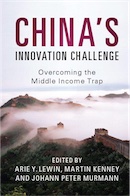
@inbook{lewin_kenney_murmann_2016c,
title = {China’s innovation challenge: Concluding reflections},
author = {Arie Y. Lewin and Martin Kenney and Johann Peter Murmann},
editor = {Arie Y. Lewin and Martin Kenney and Johann PeterEditors Murmann},
doi = {10.1017/CBO9781316422267.017},
year = {2016},
date = {2016-01-01},
urldate = {2016-01-01},
booktitle = {China's Innovation Challenge: Overcoming the Middle-Income Trap},
pages = {418–425},
publisher = {Cambridge University Press},
chapter = {16},
abstract = {The chapter reflects on China’s dramatic economic achievements over the past four decades and the complex task that policy makers face in continuing China’s progress toward attaining a high-income economy. It argues that, even though no one can predict with any certainty today whether China will continue its growth path or fall into the middle-income trap, it will become increasingly clear in the years to come whether the optimistic or the pessimistic outlook on China’s ability to develop an innovative economy turns out to be correct. The best way to gauge Chinese progress is to track a few salient indicators and compile a “Chinese Innovation Capacity Growth Dashboard.” The proposed indicators include the effectiveness of its intellectual property system, its R&D resource allocation, and its exploitation of foreign R&D assets; the share of resources flowing to state-owned enterprises, of new-to-world innovations, and of papers in leading scientific journals; the ease of starting new firms; the level of financing for startups and small and medium-size enterprises; the autonomy of Chinese universities; and institutionalized trust.},
keywords = {Innovation, Innovation Index},
pubstate = {published},
tppubtype = {inbook}
}
@inbook{lewin_kenney_murmann_2016b,
title = {China’s innovation challenge: An introduction},
author = {Arie Y. Lewin and Martin Kenney and Johann Peter Murmann},
editor = {Arie Y. Lewin and Martin Kenney and Johann Peter Murmann},
doi = {10.1017/CBO9781316422267.002},
year = {2016},
date = {2016-01-01},
urldate = {2016-01-01},
booktitle = {China's Innovation Challenge: Overcoming the Middle-Income Trap},
pages = {1–31},
publisher = {Cambridge University Press},
chapter = {10},
abstract = {The current Chinese development model is nearing its limits. The World Bank has cautioned that China could find itself in a “middle-income trap”. China recognizes that it must dramatically increase its capacity for innovation to avoid this trap. This chapter provides an introduction to the enormous complexities and challenges that China faces in transforming the diverse resources available to it for creating an innovation-based economy. It describes how China has over the past four decades developed from being largely isolated and irrelevant to the world economy to becoming the world’s second-largest economy. The chapter lays out two diametrically opposed scenarios for the future development of the Chinese economy. The first, optimistic scenario argues that China can build ever-stronger innovation capability and become a high-income nation. The second, more pessimistic scenario makes the case that, without radical reforms, existing Chinese political and economic institutions will inexorably relegate China to the middle-income trap. The chapter also introduces 14 essays by leading international scholars that collectively discuss with frankness the opportunities and challenges China faces across the different aspects of its society. It does so this by sketching the role of institutions, history, politics, culture, and competition in shaping the attitudes and capacities of individuals, firms, and entire sectors to become more innovative. },
keywords = {Innovation},
pubstate = {published},
tppubtype = {inbook}
}
@book{lewin_kenney_murmann_2016,
title = {China's Innovation Challenge: Overcoming the Middle-Income Trap},
editor = {Arie Y. Lewin and Martin Kenney and Johann Peter Murmann},
doi = {10.1017/CBO9781316422267},
year = {2016},
date = {2016-01-01},
urldate = {2016-01-01},
publisher = {Cambridge University Press},
abstract = {The miracle growth of the Chinese economy has decreased from a compound annual growth rate of 10% to less than 7% in 2015. The two engines of growth - export on a scale never before witnessed and massive infrastructure investments - are reaching the point of diminishing returns. This poses the central question which is explored in this book - can China escape the middle-income trap? Assuming current political arrangements remain unchanged and that it does not or cannot adopt Western sociopolitical economic regimes, can China develop an indigenous growth model centered on innovation? This compilation gathers leading Chinese and other international scholars to consider the daunting challenges and complexities of building an innovation-driven Chinese growth model. Providing several comprehensive perspectives, it examines key areas such as the institutional system, technology, sociocultural forces and national policy. The analyses and their conclusions range from strong optimism to deep pessimism about China's future.},
keywords = {Innovation},
pubstate = {published},
tppubtype = {book}
}

@inbook{Murmann2016,
title = {Nelson, Richard R. (Born 1930)},
author = {Johann Peter Murmann},
doi = {10.1057/978-1-349-94848-2_646-1},
isbn = {9781349948482},
year = {2016},
date = {2016-00-00},
urldate = {2016-00-00},
booktitle = {The Palgrave Encyclopedia of Strategic Management},
pages = {1--4},
publisher = {Palgrave Macmillan UK},
keywords = {},
pubstate = {published},
tppubtype = {inbook}
}
2015

@article{Bermiss2014,
title = {Who matters more? The impact of functional background and top executive mobility on firm survival},
author = {Y. Sekou Bermiss and Johann P. Murmann},
doi = {10.1002/smj.2320},
issn = {1097-0266},
year = {2015},
date = {2015-11-00},
urldate = {2015-11-00},
journal = {Strategic Management Journal},
volume = {36},
number = {11},
pages = {1697--1716},
publisher = {Wiley},
abstract = {<jats:p>
<jats:italic>Do some top executives matter more than others? Integrating insights from upper echelons and executive mobility research, we suggest that the functional roles performed by top executives shape their value to the firm. We examine the effects of interfirm executive mobility on firm survival for New York City advertising firms from 1924 to 1996. We find that, while losing any top executive is damaging, the loss of a top executive whose functional role focuses on internal firm processes is more detrimental to firm survival than losing a top executive whose functional role focuses on managing external exchange relationships. Additionally, in situations when multiple executives leave simultaneously, firms are more negatively affected when the group departing is functionally heterogeneous</jats:italic>
. Copyright © 2014 John Wiley & Sons, Ltd.
</jats:p>},
keywords = {},
pubstate = {published},
tppubtype = {article}
}
<jats:italic>Do some top executives matter more than others? Integrating insights from upper echelons and executive mobility research, we suggest that the functional roles performed by top executives shape their value to the firm. We examine the effects of interfirm executive mobility on firm survival for New York City advertising firms from 1924 to 1996. We find that, while losing any top executive is damaging, the loss of a top executive whose functional role focuses on internal firm processes is more detrimental to firm survival than losing a top executive whose functional role focuses on managing external exchange relationships. Additionally, in situations when multiple executives leave simultaneously, firms are more negatively affected when the group departing is functionally heterogeneous</jats:italic>
. Copyright © 2014 John Wiley & Sons, Ltd.
</jats:p>
@online{nokey,
title = {China’s Path to Innovation by Xiaolan Fu},
author = {Johann Peter Murmann},
url = {http://www.economic-evolution.net/index.php/weblog/booksandreviewsfull/322},
year = {2015},
date = {2015-07-28},
urldate = {2015-07-28},
abstract = {China's economic development is one of the great stories of our time. Today (July 28, 2015) we are starting our special focus on China with a review new book on the development of China's innovative capacity. China's Path to Innovation written by the Oxford Professor Xiaolan Fu. Although a new trade press book seems to come out almost every week on China's innovative capacity, there are relatively few scholarly treatments on the subjects. For this reason, Xiaolan Fu’s book China's Path to Innovation (Cambridge University Press, 2015) is a welcome addition to the literature.
},
keywords = {Innovation},
pubstate = {published},
tppubtype = {online}
}

@article{Murmann2015,
title = {Deepening the conversation between business history and evolutionary economics},
author = {Johann Peter Murmann},
doi = {10.1080/00076791.2014.975122},
issn = {1743-7938},
year = {2015},
date = {2015-07-04},
urldate = {2015-07-04},
journal = {Business History},
volume = {57},
number = {5},
pages = {705--715},
publisher = {Informa UK Limited},
keywords = {},
pubstate = {published},
tppubtype = {article}
}

@article{Murmann2015b,
title = {The role of home country demand in the internationalization of new ventures},
author = {Johann Peter Murmann and Salih Zeki Ozdemir and Deepak Sardana},
doi = {10.1016/j.respol.2015.03.002},
issn = {0048-7333},
year = {2015},
date = {2015-07-00},
urldate = {2015-07-00},
journal = {Research Policy},
volume = {44},
number = {6},
pages = {1207--1225},
publisher = {Elsevier BV},
keywords = {},
pubstate = {published},
tppubtype = {article}
}

@inbook{Murmann2015c,
title = {Evolutionary Perspectives},
author = {Johann Peter Murmann},
doi = {10.1002/9781118785317.weom110148},
year = {2015},
date = {2015-01-21},
urldate = {2015-01-21},
journal = {Blackwell Encyclopedic Dictionnary of Management: Organizational Behavior},
volume = {11},
issue = {2nd Edition},
pages = {1--1},
publisher = {Wiley},
abstract = {<jats:title>Abstract</jats:title>
<jats:p>Evolutionary perspectives contend that complex structures in the social and the biological world have developed over time through causal processes that require little or no foresight but considerable trial and error. Evolutionary thought in organizational analysis comprises two distinct intellectual lines. The first, concerned with organizational change, relies to a considerable extent on a selection logic in which change comes about through the birth and death of individual entities that make up a population of similar things. This account of change contrasts sharply with theories in which omniscient actors perfectly transform individual entities to meet new environmental conditions. The second line of evolutionary thought draws on evolutionary psychology to explain the behavior of human beings in organizational settings in terms of the evolved nature of the human mind and body</jats:p>},
keywords = {},
pubstate = {published},
tppubtype = {inbook}
}
<jats:p>Evolutionary perspectives contend that complex structures in the social and the biological world have developed over time through causal processes that require little or no foresight but considerable trial and error. Evolutionary thought in organizational analysis comprises two distinct intellectual lines. The first, concerned with organizational change, relies to a considerable extent on a selection logic in which change comes about through the birth and death of individual entities that make up a population of similar things. This account of change contrasts sharply with theories in which omniscient actors perfectly transform individual entities to meet new environmental conditions. The second line of evolutionary thought draws on evolutionary psychology to explain the behavior of human beings in organizational settings in terms of the evolved nature of the human mind and body</jats:p>2014

@article{Murmann2014,
title = {How Fast Can Firms Grow?},
author = {Johann Peter Murmann and Jenny Korn and Hagen Worch},
doi = {10.1515/jbnst-2014-2-307},
issn = {2366-049X},
year = {2014},
date = {2014-04-01},
urldate = {2014-04-01},
volume = {234},
number = {2-3},
pages = {210--233},
publisher = {Walter de Gruyter GmbH},
abstract = {<jats:title>Summary</jats:title>
<jats:p> Building on recent research on dynamic, high-growth firms - so-called “gazelles” - this paper explores a simple question that is important in both theoretical and practical terms: What is the fastest rate at which firms can grow? Based on a sample of seven high-growth firms (Cisco, GM, IBM, Microsoft, Sears, Starbucks, and US Steel), we find that 162% is the maximum sales growth rate in any one year that an established company can grow without mergers and acquisitions, while the maximum rate of employee growth is approximately 115% even including some mergers and acquisitions. All of the companies in our sample attained a maximum sales growth rate of above 50%, with most hovering around 75%. Furthermore, the firms’ growth rates exhibit similar patterns. No company experienced its maximum sales growth rate toward the latter part of its history. Every company experienced its slowest employee growth rate after attaining its maximum employee growth rate, usually within a decade of one another. Most importantly, all firms show an average sales growth that exceeds the average employee growth. This finding is an indication that successful growing firms have a superior capability to continuously improve employment efficiency and adjust organizational structures to suit an increasing workforce.</jats:p>},
keywords = {},
pubstate = {published},
tppubtype = {article}
}
<jats:p> Building on recent research on dynamic, high-growth firms - so-called “gazelles” - this paper explores a simple question that is important in both theoretical and practical terms: What is the fastest rate at which firms can grow? Based on a sample of seven high-growth firms (Cisco, GM, IBM, Microsoft, Sears, Starbucks, and US Steel), we find that 162% is the maximum sales growth rate in any one year that an established company can grow without mergers and acquisitions, while the maximum rate of employee growth is approximately 115% even including some mergers and acquisitions. All of the companies in our sample attained a maximum sales growth rate of above 50%, with most hovering around 75%. Furthermore, the firms’ growth rates exhibit similar patterns. No company experienced its maximum sales growth rate toward the latter part of its history. Every company experienced its slowest employee growth rate after attaining its maximum employee growth rate, usually within a decade of one another. Most importantly, all firms show an average sales growth that exceeds the average employee growth. This finding is an indication that successful growing firms have a superior capability to continuously improve employment efficiency and adjust organizational structures to suit an increasing workforce.</jats:p>
@article{murmann_2014,
title = {Reflections on Choosing the Appropriate Level of Abstraction in Social Science Research},
author = {Johann Peter Murmann},
url = {http://professor-murmann.net/publications/Murmann-2014-Management_and_Organization_Review.pdf},
doi = {10.1017/S1740877600004319},
year = {2014},
date = {2014-01-01},
urldate = {2014-01-01},
journal = {Management and Organization Review},
volume = {10},
number = {3},
pages = {381–389},
publisher = {Cambridge University Press},
abstract = {Although researchers often do it subconsciously, every explanation involves choosing a level of abstraction at which the argument proceeds. The dominant North American style of research in Organization Theory, Strategy, and International Business encourages researchers to frame their explanations at the highest level of abstraction where country-level contextual factors are suppressed or ignored. Yet to provide powerful explanations for recent developments in China, researchers are drawn to a greater level of context specificity. This tension is evident in the Child and Marinova (2014) paper. One way to reduce the tension is to identify general causal mechanisms that combine in different ways to produce different results depending on context. This research strategy is more effective than seeking invariant, general patterns of development across all times and places.},
keywords = {Private Enterprise, SOEs, Unit of Analysis},
pubstate = {published},
tppubtype = {article}
}
2013

@inbook{Murmann2013b,
title = {Scaffolding in Economics, Management, and the Design of Technologies},
author = {Johann Peter Murmann},
doi = {10.7551/mitpress/9780262019552.003.0055},
isbn = {9780262314787},
year = {2013},
date = {2013-11-08},
urldate = {2013-11-08},
booktitle = {Developing Scaffolds in Evolution, Culture, and Cognition},
pages = {287--306},
publisher = {The MIT Press},
keywords = {},
pubstate = {published},
tppubtype = {inbook}
}
@article{Murmann2012b,
title = {The co-development of industrial sectors and academic disciplines},
author = {J. P. Murmann},
doi = {10.1093/scipol/scs083},
issn = {1471-5430},
year = {2013},
date = {2013-04-01},
urldate = {2013-04-01},
journal = {Science and Public Policy},
volume = {40},
number = {2},
pages = {229--246},
publisher = {Oxford University Press (OUP)},
keywords = {},
pubstate = {published},
tppubtype = {article}
}

@article{Murmann2012,
title = {Successful entrepreneurs minimize risk},
author = {Johann Peter Murmann and Deepak Sardana},
doi = {10.1177/0312896212444114},
issn = {1327-2020},
year = {2013},
date = {2013-04-00},
urldate = {2013-04-00},
journal = {Australian Journal of Management},
volume = {38},
number = {1},
pages = {191--215},
publisher = {SAGE Publications},
abstract = {<jats:p> Many scholars see entrepreneurs as action-oriented individuals who use rules of thumb and other mental heuristics to make decisions, but who do little systematic planning and analysis. We argue that what distinguishes successful from unsuccessful entrepreneurs is precisely that the former vary their decision-making styles, sometimes relying on heuristics and sometimes relying on systematic analysis. In our proposed framework, successful entrepreneurs assess their level of expertise and the level of ambiguity in a particular decision context and then tailor their decision-making process to reduce risk. </jats:p>},
keywords = {},
pubstate = {published},
tppubtype = {article}
}

@article{Murmann2013,
title = {The Coevolution of Industries and Important Features of Their Environments},
author = {Johann Peter Murmann},
doi = {10.1287/orsc.1110.0718},
issn = {1526-5455},
year = {2013},
date = {2013-02-00},
urldate = {2013-02-00},
journal = {Organization Science},
volume = {24},
number = {1},
pages = {58--78},
publisher = {Institute for Operations Research and the Management Sciences (INFORMS)},
abstract = {<jats:p>As the rate of innovation increases, organizational environments are becoming faster and more complex, posing greater challenges for organizations to adapt. This study argues that the concept of coevolution offers a bridge between the prescient adaptationist and ex post selectionist perspectives of organizational change to account for the increasing rates of change. The mutual causal influences in a coevolutionary relationship help explain why competing sets of firms or individual firms can capture dominant shares in product markets. Using a comparative historical method and drawing on evidence from five countries over a 60-year period, this paper inquires how precisely coevolutionary processes work in shaping the evolution of industries and important features of their environments. It identifies—in the context of the synthetic dye industry—three causal mechanisms (exchange of personnel, commercial ties, and lobbying) and suggests how they acted as levers on the fundamental mechanisms of evolution. Understanding the levers is important for managing change in a world that is increasingly becoming coevolutionary, requiring managers to focus more on the emergent, system-level properties of their environments.</jats:p>},
keywords = {},
pubstate = {published},
tppubtype = {article}
}
2012

@inbook{Murmann2012c,
title = {Marrying History and Social Science in Strategy Research},
author = {Johann Peter Murmann},
doi = {10.1108/s0742-3322(2012)0000029008},
isbn = {9781781900253},
year = {2012},
date = {2012-08-21},
urldate = {2012-08-21},
booktitle = {Advances in Strategic Management},
pages = {89--115},
publisher = {Emerald Group Publishing Limited},
keywords = {},
pubstate = {published},
tppubtype = {inbook}
}
2011

@article{10.1093/icc/dtr070,
title = {Regional institutions, ownership transformation, and migration of industrial leadership in China: the case of the Chinese synthetic dye industry, 1978–2008},
author = {Hong Jiang and Johann Peter Murmann},
url = {https://doi.org/10.1093/icc/dtr070},
doi = {10.1093/icc/dtr070},
issn = {0960-6491},
year = {2011},
date = {2011-01-01},
urldate = {2011-01-01},
journal = {Industrial and Corporate Change},
volume = {21},
number = {4},
pages = {933-970},
abstract = {Scholars have emphasized the gradual ownership transformation of enterprises as a key driver of the Chinese economy's unprecedented growth. However, little work has been done on the issue of whether this transformation process takes place evenly across the various regions in China. This article describes the important role of regional institutions in shaping the ownership-based competitiveness of local enterprises and the migration of industries across regions. In the case of the Chinese synthetic dye industry, the passing of leadership from state-owned enterprises (SOEs) to collectively owned enterprises (COEs) and then to private enterprises (PEs) was accompanied by a concurrent leadership migration from one region to another. The article contends that this simultaneous occurrence was not accidental. Four institutional constraints—the degree of central supervision, the local labor arrangements, the local social welfare provision, and the degree of ambiguity in property rights—retarded the rise of new ownership forms in the previously dominant regions. This gave other regions the opening to take over leadership positions by providing a more favorable institutional context for new ownership forms. These findings are likely to apply to all of the Chinese manufacturing industries that existed prior to 1978 and that subsequently did not experience significant technological changes and were not highly protected by the government.},
keywords = {COEs, Corporate Forms, Dye Industry, Evolutionary Theory, Private Enterprise, Regional Advantage, SOEs},
pubstate = {published},
tppubtype = {article}
}
2010

@article{Murmann2010,
title = {Constructing Relational Databases to Study Life Histories on Your PC or Mac},
author = {Johann Peter Murmann},
doi = {10.1080/01615440.2010.496442},
issn = {1940-1906},
year = {2010},
date = {2010-07-29},
urldate = {2010-07-29},
journal = {Historical Methods: A Journal of Quantitative and Interdisciplinary History},
volume = {43},
number = {3},
pages = {109--123},
publisher = {Informa UK Limited},
keywords = {},
pubstate = {published},
tppubtype = {article}
}
2009

@article{Järvinen2009,
title = {Alternative Paths to Competitive Advantage: A Fuzzy-Set Analysis of the Origins of Large Firms},
author = {Joonas Järvinen and Juha-Antti Lamberg and Johan-Peter Murmann and Jari Ojala},
doi = {10.1080/13662710903371066},
issn = {1469-8390},
year = {2009},
date = {2009-12-00},
urldate = {2009-12-00},
journal = {Industry and Innovation},
volume = {16},
number = {6},
pages = {545--574},
publisher = {Informa UK Limited},
keywords = {},
pubstate = {published},
tppubtype = {article}
}
2007
@article{PETERMURMANN2007,
title = {Automatic Coding of Printed Materials},
author = {JOHANN PETER MURMANN and ERNST HOMBURG and RUUD GEVEN and Y. SEKOU BERMISS and ALFONZO FORGIONE},
doi = {10.3366/e1753854808000244},
issn = {1755-1706},
year = {2007},
date = {2007-10-00},
urldate = {2007-10-00},
journal = {IJHAC},
volume = {1},
number = {2},
pages = {151--185},
publisher = {Edinburgh University Press},
keywords = {},
pubstate = {published},
tppubtype = {article}
}
2006

@article{Murmann2006,
title = {Toward a systematic framework for research on dominant designs, technological innovations, and industrial change},
author = {Johann Peter Murmann and Koen Frenken},
doi = {10.1016/j.respol.2006.04.011},
issn = {0048-7333},
year = {2006},
date = {2006-09-00},
urldate = {2006-09-00},
journal = {Research Policy},
volume = {35},
number = {7},
pages = {925--952},
publisher = {Elsevier BV},
keywords = {},
pubstate = {published},
tppubtype = {article}
}
2005
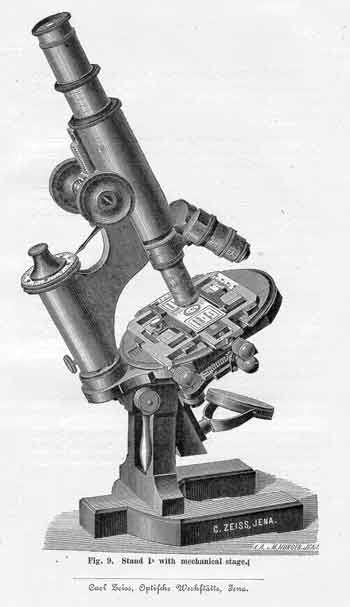
@article{Buenstorf2005,
title = {Ernst Abbe’s scientific management: theoretical insights from a nineteenth-century dynamic capabilities approach},
author = {Guido Buenstorf and Johann Peter Murmann},
doi = {10.1093/icc/dth067},
issn = {1464-3650},
year = {2005},
date = {2005-08-01},
urldate = {2005-08-01},
volume = {14},
number = {4},
pages = {543--578},
publisher = {Oxford University Press (OUP)},
keywords = {},
pubstate = {published},
tppubtype = {article}
}
@inbook{Murmann2005,
title = {Toward a Systematic Framework for Research on Dominant Designs, Technological Innovations, and Industrial Change},
author = {Johann Peter Murmann and Koen Frenken},
editor = {Jason Potts and Kurt Dopfer},
doi = {10.2139/ssrn.737063},
issn = {1556-5068},
year = {2005},
date = {2005-00-00},
urldate = {2005-00-00},
journal = {SSRN Journal},
publisher = {Elsevier BV},
keywords = {},
pubstate = {published},
tppubtype = {inbook}
}
2003

@book{Murmann2003b,
title = {Knowledge and Competitive Advantage},
author = {Johann Peter Murmann},
doi = {10.1017/cbo9780511510953},
year = {2003},
date = {2003-11-10},
urldate = {2003-11-10},
publisher = {Cambridge University Press},
abstract = {<jats:p>A comparison of the development of the synthetic dye industry in Great Britain, Germany, and the US. The rise of this industry constitutes an important chapter in business, economic, and technological history because synthetic dyes - invented in 1857 - represent the first time that a scientific discovery quickly gave rise to a new industry. British firms led the industry for the next eight years, but German firms came to dominate the industry for decades before WWI, while American firms played only a minor role during the entire period. This study identifies differences in educational institutions and patent laws as the key reasons for German leadership in this industry. Successful firms had strong ties to the centers of organic chemistry knowledge. The book also argues that a complex coevolutionary process linking firms, technology and national institutions resulted in very different degrees of industrial success for dye firms in the three countries.</jats:p>},
keywords = {},
pubstate = {published},
tppubtype = {book}
}

@article{Stephan2003,
title = {Bringing Managers into Theories of Multimarket Competition: CEOs and the Determinants of Market Entry},
author = {John Stephan and Johann Peter Murmann and Warren Boeker and Jerry Goodstein},
doi = {10.1287/orsc.14.4.403.17484},
issn = {1526-5455},
year = {2003},
date = {2003-08-00},
urldate = {2003-08-00},
journal = {Organization Science},
volume = {14},
number = {4},
pages = {403--421},
publisher = {Institute for Operations Research and the Management Sciences (INFORMS)},
abstract = {<jats:p> Multimarket (or multipoint) contact has been shown to deter aggressive actions by rivals toward each other, producing a situation of mutual forbearance among firms. To create this deterrent capability, however, firms must enter each others' markets, which is just the kind of action that the deterrent is supposed to limit. This study explores the questions: Under what conditions are firms likely to behave aggressively toward their multimarket rivals by entering their markets and when will they engage in mutual forbearance? We describe how the effect of multimarket contact on the market-entry moves of a firm changes as the level of contact a firm has with its rivals increases. We draw on competitive intelligence and decision-making theory to argue that the competitive advantages associated with multimarket contact are supplemented by the fact that a firm's multimarket competitors serve as a readily available model to reduce the uncertainty associated with market-entry decisions. We hypothesize that these factors lead firms to prefer, up to the point where forbearance concerns become paramount, to enter the markets in which their multipoint rivals already compete. We also argue that once multimarket contact levels reach the point where forbearance begins to operate, these levels also serve to stabilize the structure through better competitive intelligence, with the result that the propensity of a firm to enter into additional markets of its multimarket rivals declines. We then extend multimarket theory by focusing on the role of the CEO. Specifically, we argue that newer and longer-tenured CEOs are likely to face different influences on their preferences for particular competitive actions. We test hypotheses that link the likelihood that CEOs will abide by the mutual interdependencies that their firm's multimarket ties represent to their tenure in the CEO position. Our findings produce support for an inverted-U-shaped relationship between multipoint contact and market entry. We also find evidence that longer-tenured CEOs are guided by their firm's multimarket relationships. Newer CEOs, however, do not seem to adopt a forbearance approach toward their firm's multimarket competitors. </jats:p><jats:p> Our findings have important implications for multimarket theory. This study is among the first to examine the role of managers within a multimarket context. We show that it is not enough for a firm to be embedded within a multimarket structure, but that for a firm to benefit from its multimarket position, its managers must be aware of this positioning and free of other influences that could cause them to behave in ways that are inconsistent with it. Because our findings show that newer CEOs can direct their firms to act in ways that are inconsistent with their firm's multimarket position, we identify an area of potential competitive vulnerability for the firm. </jats:p>},
keywords = {},
pubstate = {published},
tppubtype = {article}
}
@inbook{2001,
title = {From the Technology Cycle to the Entrepreneurship Dynamic: The Social Context of Entrepreneurial Innovation},
author = {Johann Peter Murmann and Michael Tushman},
editor = {Claudia Bird Schoonhoven and Elaine Romanelli},
doi = {10.1108/jsbed.2003.10.2.210.2},
issn = {1462-6004},
year = {2003},
date = {2003-06-01},
urldate = {2003-06-01},
volume = {1},
pages = {178-206},
publisher = {Emerald},
keywords = {},
pubstate = {published},
tppubtype = {inbook}
}

@article{Murmann2003,
title = {Evolutionary Thought in Management and Organization Theory at the Beginning of the New Millennium},
author = {Johann Peter Murmann and Howard E. Aldrich and Daniel Levinthal and Sidney G. Winter},
doi = {10.1177/1056492602250516},
issn = {1552-6542},
year = {2003},
date = {2003-03-00},
urldate = {2003-03-00},
journal = {Journal of Management Inquiry},
volume = {12},
number = {1},
pages = {22--40},
publisher = {SAGE Publications},
abstract = {<jats:p>The beginning of a new millennium provides a welcome opportunity to take stock of the accomplishments, open questions, and most promising research avenues of evolutionary models in management and organization theory. Johann Peter Murmann has invited Howard Aldrich, Daniel Levinthal, and Sidney Winter to appraise the state of the art in evolutionary research and where scholarly efforts should go in the new millennium. The panel also clarified their positions by answering questions that Johann Peter Murmann solicited from the scholarly community in response to the panel's dialogue.</jats:p>},
keywords = {},
pubstate = {published},
tppubtype = {article}
}

@inbook{Murmann2003c,
title = {Evolutionary Thought in Management and Organization Theory at the Beginning of the New Millennium},
author = {Johann Peter Murmann and Howard E. Aldrich and Daniel Levinthal and Sidney G. Winter},
editor = {John Child},
doi = {10.1177/1056492602250516},
issn = {1552-6542},
year = {2003},
date = {2003-03-00},
urldate = {2003-03-00},
journal = {Journal of Management Inquiry},
volume = {12},
number = {1},
pages = {22--40},
publisher = {SAGE Publications},
abstract = {<jats:p>The beginning of a new millennium provides a welcome opportunity to take stock of the accomplishments, open questions, and most promising research avenues of evolutionary models in management and organization theory. Johann Peter Murmann has invited Howard Aldrich, Daniel Levinthal, and Sidney Winter to appraise the state of the art in evolutionary research and where scholarly efforts should go in the new millennium. The panel also clarified their positions by answering questions that Johann Peter Murmann solicited from the scholarly community in response to the panel's dialogue.</jats:p>},
keywords = {},
pubstate = {published},
tppubtype = {inbook}
}
My Publications
Individual foresight: Concept, operationalization, and correlates Journal Article In: International Journal of Forecasting, vol. 41, no. 4, pp. 1521–1538, 2025, ISSN: 0169-2070. In: Manag. Organ. Rev., vol. 20, no. 4, pp. 695–696, 2024, ISSN: 1740-8784. The organizational and technological origins of the U.S. shale gas revolution, 1947 to 2012 Journal Article In: vol. 33, no. 1, pp. 106–125, 2024, ISSN: 1464-3650. The Rise of China and the Specter of a Superpower War: Avoiding the Curse of History at the Grassroots Journal Article In: Management and Organization Review, vol. 20, no. 6, pp. 946–957, 2024. Debate on Informal Interpersonal Networks: Guanxi vs. Wasta Journal Article In: Manag. Organ. Rev., vol. 19, no. 5, pp. 1039–1039, 2023, ISSN: 1740-8784. Functional Knowledge versus Strategic Knowledge: What Type of Knowledge Matters Most for the Long-Term Performance of Startups Journal Article In: Management and Organization Review, vol. 19, no. 3, pp. 417-461, 2023. The Rise of China's Digital Economy: An Overview Journal Article In: Management and Organization Review, vol. 18, no. 4, pp. 790–802, 2022. China Innovation Capacity Growth Index 2015 and 2020 Journal Article In: Management and Organization Review, vol. 17, no. 4, pp. 861-867, 2021. A Dynamic Perspective on Huawei Journal Article In: Management and Organization Review, vol. 17, no. 5, pp. 1087-1100, 2021. In: Strategy Science, vol. 6, no. 4, pp. 265-445, 2021. Historical methods in the social sciences: Commentary on Schoemaker 2020 Journal Article In: Futures & Foresight Science, vol. 2, no. 3-4, 2020, ISSN: 2573-5152. Huawei’s Intellectual Property Management Transformation Book Chapter In: Wu, Xiaobo; Murmann, Johann Peter; Huang, Can; Guo, Bin (Ed.): The Management Transformation of Huawei: From Humble Beginnings to Global Leadership, Chapter 9, pp. 347–380, Cambridge University Press, 2020. The Management Transformation of Huawei: From Humble Beginnings to Global Leadership Book Cambridge University Press, 2020. The Management Transformation of Huawei: An Overview Book Chapter In: Wu, Xiaobo; Murmann, Johann Peter; Huang, Can; Guo, Bin (Ed.): The Management Transformation of Huawei: From Humble Beginnings to Global Leadership, pp. 1–70, Cambridge University Press, 2020. Transforming Product Development at Huawei: The IPD Initiative Book Chapter In: Wu, Xiaobo; Murmann, Johann Peter; Huang, Can; Guo, Bin (Ed.): The Management Transformation of Huawei: From Humble Beginnings to Global Leadership, Chapter 3, pp. 110–135, Cambridge University Press, 2020. The Transformation of Huawei’s HR System Book Chapter In: Wu, Xiaobo; Murmann, Johann Peter; Huang, Can; Guo, Bin (Ed.): The Management Transformation of Huawei: From Humble Beginnings to Global Leadership, Chapter 6, pp. 209–243, Cambridge University Press, 2020. The Management Transformation of Huawei: Concluding Thoughts from a Comparative Perspective Book Chapter In: Wu, Xiaobo; Murmann, Johann Peter; Huang, Can; Guo, Bin (Ed.): The Management Transformation of Huawei: From Humble Beginnings to Global Leadership, Chapter 10, pp. 381–410, Cambridge University Press, 2020. Huawei’s R&D Management Transformation Book Chapter In: Wu, Xiaobo; Murmann, Johann Peter; Huang, Can; Guo, Bin (Ed.): The Management Transformation of Huawei: From Humble Beginnings to Global Leadership, Chapter 8, pp. 292–346, Cambridge University Press, 2020. Innovation and Entrepreneurship in India: An Overview Journal Article In: Manag. Organ. Rev., vol. 15, no. 03, pp. 467–493, 2019, ISSN: 1740-8784. What Does the Success of Tesla Mean for the Future Dynamics in the Global Automobile Sector? Journal Article In: Management and Organization Review, vol. 14, no. 3, pp. 471–480, 2018. The Critique of Empirical Social Science: New Policies atManagement and Organization Review Journal Article In: Manag. Organ. Rev., vol. 12, no. 4, pp. 649–658, 2016, ISSN: 1740-8784. Using simulation experiments to test historical explanations: the development of the German dye industry 1857-1913 Journal Article In: J Evol Econ, vol. 26, no. 4, pp. 907–932, 2016, ISSN: 1432-1386. China’s innovation challenge: Concluding reflections Book Chapter In: Lewin, Arie Y.; Kenney, Martin; Murmann, Johann PeterEditors (Ed.): China's Innovation Challenge: Overcoming the Middle-Income Trap, Chapter 16, pp. 418–425, Cambridge University Press, 2016. China’s innovation challenge: An introduction Book Chapter In: Lewin, Arie Y.; Kenney, Martin; Murmann, Johann Peter (Ed.): China's Innovation Challenge: Overcoming the Middle-Income Trap, Chapter 10, pp. 1–31, Cambridge University Press, 2016. China's Innovation Challenge: Overcoming the Middle-Income Trap Book Cambridge University Press, 2016. Nelson, Richard R. (Born 1930) Book Chapter In: The Palgrave Encyclopedia of Strategic Management, pp. 1–4, Palgrave Macmillan UK, 2016, ISBN: 9781349948482. Who matters more? The impact of functional background and top executive mobility on firm survival Journal Article In: Strategic Management Journal, vol. 36, no. 11, pp. 1697–1716, 2015, ISSN: 1097-0266. China’s Path to Innovation by Xiaolan Fu Online 2015, visited: 28.07.2015. Deepening the conversation between business history and evolutionary economics Journal Article In: Business History, vol. 57, no. 5, pp. 705–715, 2015, ISSN: 1743-7938. The role of home country demand in the internationalization of new ventures Journal Article In: Research Policy, vol. 44, no. 6, pp. 1207–1225, 2015, ISSN: 0048-7333. Evolutionary Perspectives Book Chapter In: vol. 11, pp. 1–1, Wiley, 2015. How Fast Can Firms Grow? Journal Article In: vol. 234, no. 2-3, pp. 210–233, 2014, ISSN: 2366-049X. Reflections on Choosing the Appropriate Level of Abstraction in Social Science Research Journal Article In: Management and Organization Review, vol. 10, no. 3, pp. 381–389, 2014. Scaffolding in Economics, Management, and the Design of Technologies Book Chapter In: Developing Scaffolds in Evolution, Culture, and Cognition, pp. 287–306, The MIT Press, 2013, ISBN: 9780262314787. The co-development of industrial sectors and academic disciplines Journal Article In: Science and Public Policy, vol. 40, no. 2, pp. 229–246, 2013, ISSN: 1471-5430. Successful entrepreneurs minimize risk Journal Article In: Australian Journal of Management, vol. 38, no. 1, pp. 191–215, 2013, ISSN: 1327-2020. The Coevolution of Industries and Important Features of Their Environments Journal Article In: Organization Science, vol. 24, no. 1, pp. 58–78, 2013, ISSN: 1526-5455. Marrying History and Social Science in Strategy Research Book Chapter In: Advances in Strategic Management, pp. 89–115, Emerald Group Publishing Limited, 2012, ISBN: 9781781900253. In: Industrial and Corporate Change, vol. 21, no. 4, pp. 933-970, 2011, ISSN: 0960-6491. Constructing Relational Databases to Study Life Histories on Your PC or Mac Journal Article In: Historical Methods: A Journal of Quantitative and Interdisciplinary History, vol. 43, no. 3, pp. 109–123, 2010, ISSN: 1940-1906. Alternative Paths to Competitive Advantage: A Fuzzy-Set Analysis of the Origins of Large Firms Journal Article In: Industry and Innovation, vol. 16, no. 6, pp. 545–574, 2009, ISSN: 1469-8390. Automatic Coding of Printed Materials Journal Article In: IJHAC, vol. 1, no. 2, pp. 151–185, 2007, ISSN: 1755-1706. Toward a systematic framework for research on dominant designs, technological innovations, and industrial change Journal Article In: Research Policy, vol. 35, no. 7, pp. 925–952, 2006, ISSN: 0048-7333. Ernst Abbe’s scientific management: theoretical insights from a nineteenth-century dynamic capabilities approach Journal Article In: vol. 14, no. 4, pp. 543–578, 2005, ISSN: 1464-3650. Toward a Systematic Framework for Research on Dominant Designs, Technological Innovations, and Industrial Change Book Chapter In: Potts, Jason; Dopfer, Kurt (Ed.): Elsevier BV, 2005, ISSN: 1556-5068. Knowledge and Competitive Advantage Book Cambridge University Press, 2003. Bringing Managers into Theories of Multimarket Competition: CEOs and the Determinants of Market Entry Journal Article In: Organization Science, vol. 14, no. 4, pp. 403–421, 2003, ISSN: 1526-5455. From the Technology Cycle to the Entrepreneurship Dynamic: The Social Context of Entrepreneurial Innovation Book Chapter In: Schoonhoven, Claudia Bird; Romanelli, Elaine (Ed.): vol. 1, pp. 178-206, Emerald, 2003, ISSN: 1462-6004. Evolutionary Thought in Management and Organization Theory at the Beginning of the New Millennium Journal Article In: Journal of Management Inquiry, vol. 12, no. 1, pp. 22–40, 2003, ISSN: 1552-6542. Evolutionary Thought in Management and Organization Theory at the Beginning of the New Millennium Book Chapter In: Child, John (Ed.): vol. 12, no. 1, pp. 22–40, SAGE Publications, 2003, ISSN: 1552-6542.2025
2024
2023
2022
2021
2020
2019
2018
2016
2015
2014
2013
2012
2011
2010
2009
2007
2006
2005
2003